Digitalisation
Development
Efficiency

As 2026 draws to a close, what should your cleaning business prepare for in 2027?
New employment laws, changing recycling requirements and growing client expectations are creating new challenges for UK cleaning companies. At the same time, developments in technology, sustainability and specialist cleaning services offer opportunities to improve operations and strengthen client relationships.
But preparing for the year ahead doesn't mean adopting every new technology or changing how your entire business operates.
The key is knowing which developments affect your company and where practical improvements will make the greatest difference.
In this guide, we'll explore the important UK cleaning industry changes coming in 2027, look at four trends shaping the sector and share practical steps to help your business prepare.
The main takeaway? Start with the requirements that apply to your business, then prioritise improvements that help you save time, support employees and deliver reliable cleaning services.
Several legal changes are scheduled to take effect in 2027. Some will affect almost every cleaning employer, while others are relevant mainly to larger companies or particular employment arrangements.
Here's an overview of the developments worth preparing for:
| Requirement | Implementation date | What it means for cleaning businesses |
|---|---|---|
| Unfair dismissal rights | 1 January 2027 | The qualifying period for ordinary unfair dismissal protection reduces from two years to six months. The cap on compensatory awards is also removed. |
| Trade union information duty | 1 January 2027 | Employers must provide workers with information about their right to join a trade union. |
| Fire and rehire restrictions | March 2027 | Stronger protections will restrict certain dismissals used to change employment terms. |
| Gender equality action plans | March/April 2027 | Employers with 250 or more employees must prepare for mandatory action plans, subject to the necessary legislation. |
| Bereavement leave | April 2027 | New bereavement leave protections, including pregnancy loss, are scheduled to take effect. |
| Flexible working and maternity protections | October 2027 | Changes to flexible working rules and enhanced dismissal protections for pregnant employees and new mothers. |
| Zero-hours contract reforms | Date to be confirmed | Planned rights relating to guaranteed hours, reasonable shift notice and certain short-notice cancellations. |
| Simpler Recycling | 31 March 2027 | Micro-businesses in England must meet workplace recycling requirements. |
| Deposit Return Scheme | 1 October 2027 | Deposits on certain drinks containers may affect waste-handling arrangements at client locations. |
Most of the employment changes discussed here apply to Great Britain (England, Scotland and Wales). Northern Ireland has separate employment legislation, and recycling requirements differ across the UK.
Implementation dates and detailed requirements may also change. You can follow developments in the UK government's Employment Rights Act implementation timetable.
One of the most significant changes for cleaning employers takes effect on 1 January 2027.
Employees will generally qualify for ordinary unfair dismissal protection after six months of employment rather than two years. The existing statutory cap on compensatory awards will also be removed.
For cleaning companies, this puts greater emphasis on structured onboarding, clear expectations and consistent performance management.
Imagine hiring a new cleaner who repeatedly struggles to meet a client´s quality standards. Rather than allowing concerns to build up, supervisors should identify problems early, provide appropriate training and document performance discussions.
The changes don't prevent cleaning companies from dismissing unsuitable employees. However, a valid reason and fair dismissal process become especially important earlier in the employment relationship.
How to prepare:
Review employment contracts, probation arrangements and dismissal procedures. Make sure supervisors understand how to address performance concerns fairly and maintain appropriate records.
Good employee management can help reduce disputes while also creating a more consistent working environment.
Few planned reforms are as closely connected to the daily operations of cleaning businesses as the changes to zero-hours and low-hours contracts.
These arrangements can provide flexibility when client demand changes. However, they can also leave employees uncertain about their working hours and income.
The planned reforms aim to give eligible workers greater predictability through:
The exact implementation date and important operational details are still being finalised.
Example: A customer cancels an evening cleaning service just a few hours before an employee is due to start. Today, that might primarily create a scheduling problem. Under the planned reforms, certain cancellations could also have financial consequences for the employer.
This highlights an important challenge: how can cleaning companies offer flexibility to clients without making employees' schedules unnecessarily unpredictable?
How to prepare:
Start reviewing actual working hours, recurring shift patterns and last-minute schedule changes.
Accurate time records and reliable planning processes can help you understand your existing arrangements and identify where changes may be needed.
Other employment developments scheduled for 2027 include restrictions on the misuse of non-disclosure agreements in harassment and discrimination cases, along with additional regulation of umbrella companies.
Larger employers should also prepare for mandatory gender equality action plans addressing gender pay gaps and support for employees experiencing menopause.
Employment legislation isn't the only area cleaning businesses should pay attention to.
In England, 31 March 2027 is the deadline for micro-businesses to comply with Simpler Recycling workplace requirements.
Most workplaces have been required to separate relevant recyclable materials, food waste and non-recyclable waste since March 2025.
However, micro-businesses with fewer than 10 full-time equivalent employees have until March 2027 to meet these requirements.
If waste handling is part of the cleaning services you provide, your employees should follow each client's recycling procedures.
Imagine your cleaners emptying bins in an office where paper, plastic and food waste are collected separately. If everything ends up in the same waste bag, the client's recycling arrangements may be undermined.
That's why clear waste-handling instructions are important, even when the 2027 deadline doesn't apply directly to your company.
For practical guidance on waste separation and your cleaning team's responsibilities, read more about your cleaning company's role in Simpler Recycling.
Another development is the Deposit Return Scheme, scheduled to launch on 1 October 2027 in England, Scotland and Northern Ireland.
The scheme will introduce refundable deposits on certain single-use plastic bottles and metal drinks containers.
Although it doesn't automatically create new obligations for cleaning contractors, clients may need to adjust how these containers are collected and stored.
How to prepare:
Review waste-handling procedures at client locations, agree responsibilities with clients and make sure employees understand which materials should be separated.
For further details, see the government's Simpler Recycling guidance.
New regulations are only part of the picture.
The cleaning industry is also evolving as businesses respond to labour challenges, changing workplaces and growing expectations around efficiency and sustainability.
According to the British Cleaning Council's 2026 research, the wider UK cleaning, hygiene and waste sector employs approximately 1.51 million people, with 78,915 businesses operating in 2025.
It's a substantial industry with considerable competition.
For cleaning companies looking to strengthen their position in 2027, four developments are particularly worth watching.
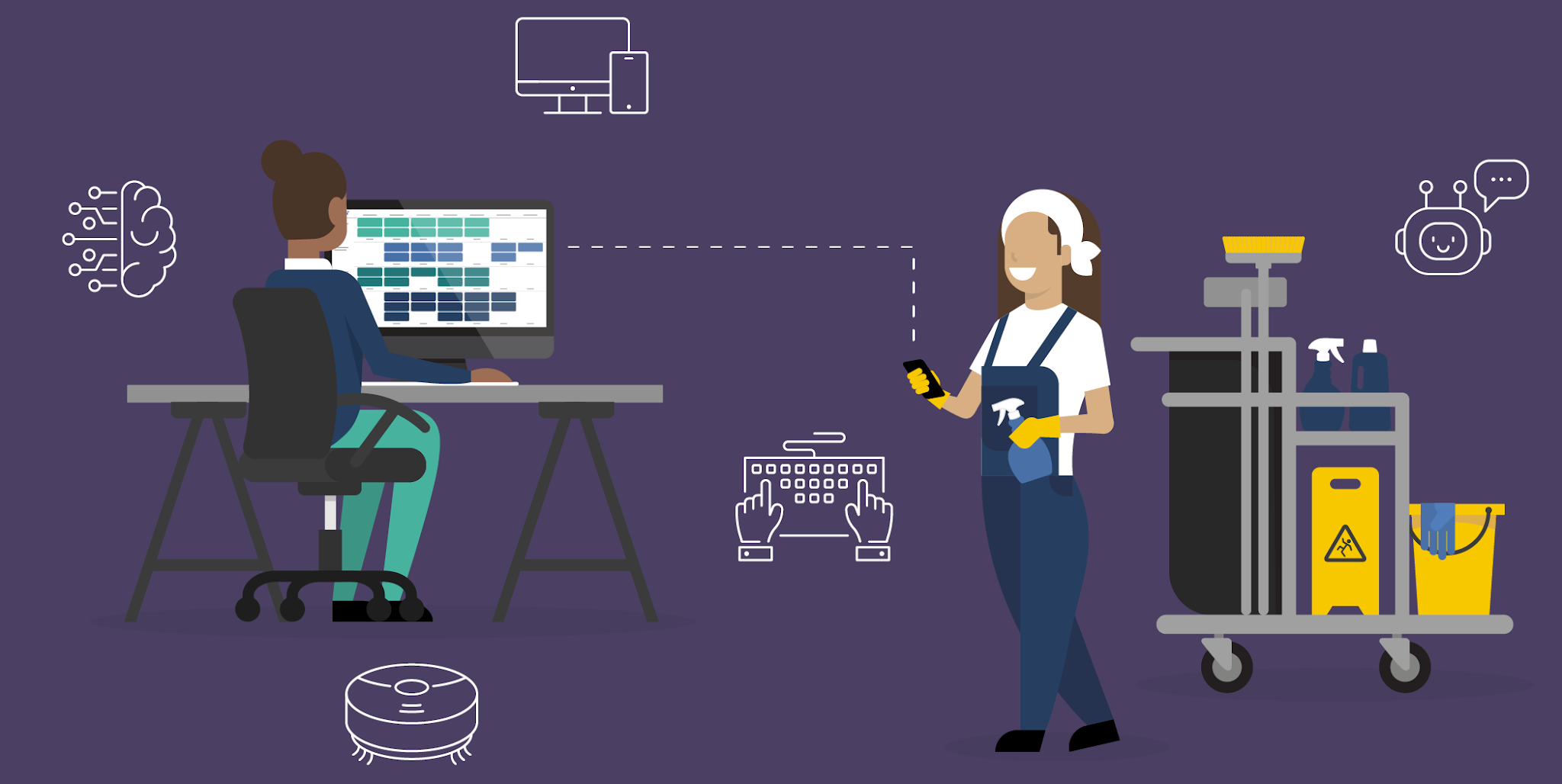
When discussing the future of cleaning, robots and artificial intelligence often attract the most attention. And both technologies are creating opportunities for commercial cleaning businesses.
However, some of the most valuable improvements in 2027 may come from something less dramatic: making everyday operations easier to manage.
Autonomous floor scrubbers and other robotic cleaning machines are becoming more established in commercial cleaning.
They can be particularly useful in large environments with repetitive cleaning requirements, such as warehouses, shopping centres and extensive corridors.
In suitable settings, robots can complete routine floor-cleaning tasks while employees focus on detailed cleaning, inspections and areas requiring specialist attention.
This collaboration between people and machines is often described as cobotics.
Another development is demand-driven cleaning.
Rather than following exactly the same routine every day, cleaning businesses can use information about building occupancy and usage to adjust cleaning priorities.
For example, an office might be busiest from Tuesday to Thursday, while Fridays see relatively little activity.
Understanding these patterns could help a cleaning company allocate resources more effectively without compromising agreed hygiene standards.
Neither approach is suitable for every business. The value depends on the working environment, customer requirements and costs involved.
AI may eventually help more cleaning companies analyse operational data, recognise scheduling patterns and optimise resources.
But businesses don't need advanced AI tools to improve their operations today.
Consider a cleaning supervisor managing employees across 15 client locations.
One employee calls in sick. A replacement must be found, the schedule updated and the correct cleaning instructions shared.
When that information is scattered across spreadsheets, text messages and paperwork, even a small change can become time-consuming.
Digital cleaning management tools can help businesses coordinate these processes more efficiently.
Depending on the system, they can support:
These capabilities also become more relevant as employment requirements and customer expectations evolve.
Reliable working-hour records can support better workforce planning, while digital cleaning documentation can help companies demonstrate that agreed services have been carried out.
Of course, recording an employee's attendance doesn't automatically prove that every cleaning task was completed correctly.
That's why scheduling, cleaning instructions and quality checks are most useful when they work together.
Where should you start?
Identify the administrative tasks that create the most friction in your business.
If last-minute schedule changes cause confusion, start with workforce planning. If customers regularly request proof of completed work, focus on cleaning documentation and quality reporting.
In 2027, the smartest technology investment may be the one that solves an everyday problem rather than the one that looks most impressive.
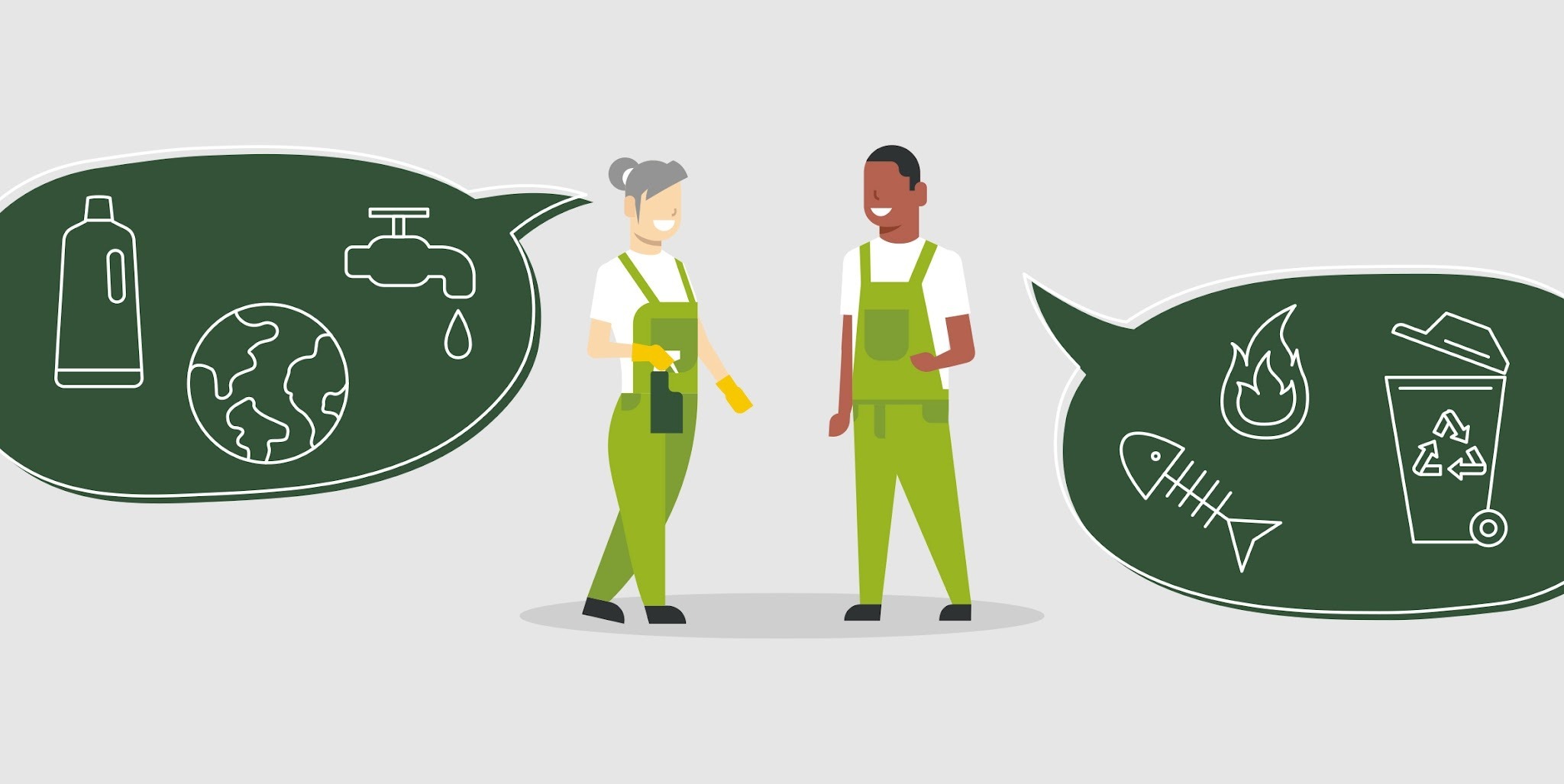 Sustainability is not a new topic in commercial cleaning.
What deserves greater attention in 2027 is how cleaning businesses demonstrate the environmental improvements they claim to deliver.
Customers may want more information about cleaning products, packaging, water consumption and waste-handling practices.
At the same time, environmental claims need to be accurate and supported by credible evidence.
The UK's Competition and Markets Authority (CMA) has established a Green Claims Code to help businesses communicate environmental benefits clearly and responsibly.
The code isn't a new requirement for 2027, but it remains relevant to cleaning companies promoting sustainable services.
For example, describing your business as environmentally friendly tells clients very little about what you actually do. Explaining that you've introduced a dosing system to control chemical consumption is more specific.
And if you can demonstrate that the system has reduced product use by a certain amount, your claim becomes more informative and credible.
The difference is simple: instead of relying on promises, you can share documented data on your energy use and CO₂e emissions.
There are several practical ways to review the environmental impact of cleaning operations.
Concentrated cleaning products may reduce packaging and transport requirements. Accurate dosing systems can help prevent unnecessary chemical consumption, while suitable microfibre cleaning methods may reduce reliance on certain products.
Newer approaches, such as enzyme-based and microorganism-based cleaning solutions, may also be worth evaluating for specific applications.
However, their effectiveness and environmental benefits should be assessed rather than assumed. For businesses looking for a structured approach, environmental management standards such as ISO 14001 can provide useful guidance.
But formal certification isn't the only starting point.
Keeping consistent records of chemical consumption, water use or waste generated can help establish whether your business is making progress.
A practical goal for 2027:
Choose one or two environmental improvements you can realistically measure.
Establish your starting point, track the results and communicate what the evidence shows.
Credible sustainability claims can help build trust and give customers a clearer reason to choose your services.

Technology may be changing the cleaning industry, but skilled and reliable employees remain essential to delivering quality services.
For many cleaning businesses, attracting and retaining those employees continues to be a challenge.
The British Cleaning Council's 2026 research highlights recruitment difficulties and an ageing workforce across the wider sector.
With an estimated 29% of workers aged over 55 and only 9% under 25, attracting new talent and retaining experienced employees are important long-term priorities.
Imagine spending several weeks recruiting and training a new cleaner, only for that employee to leave after three months.
Now consider what happens if that situation repeats several times throughout the year.
The cost isn't limited to recruitment and training.
When experienced employees leave, cleaning companies may also lose valuable knowledge of client locations, established working routines and relationships that support consistent service quality.
Retaining good employees is therefore more than an HR priority. It can directly influence customer satisfaction and operational stability.
And improving retention doesn't always require major changes.
Providing schedules in advance gives employees greater predictability. Clear cleaning instructions reduce uncertainty, while reliable communication helps everyone respond to unexpected changes.
Recognition, fair treatment and opportunities to develop skills can also contribute to a better working environment.
These practices are particularly relevant as planned employment reforms place greater attention on predictable working arrangements.
Cleaning involves considerably more expertise than simply completing a task list.
Depending on their responsibilities, employees may need knowledge of hygiene procedures, chemical safety, specialist equipment, ergonomics and client-specific quality requirements.
In healthcare facilities, laboratories and other sensitive environments, these skills become even more important.
Providing appropriate training and development opportunities can improve cleaning quality while helping employees feel more confident in their work.
What can your business do in 2027?
Review employee turnover, recurring scheduling difficulties and training needs.
Ask employees what makes their working day easier or more difficult.
Their feedback may highlight practical improvements that benefit both your workforce and your customers.
Client requirements don't always remain the same throughout the year.
Hybrid working, changing business hours and different patterns of building use can influence how frequently commercial spaces need cleaning.
Meanwhile, specialised environments require increasingly specific cleaning knowledge and quality controls.
For cleaning companies, both developments create opportunities to differentiate their services.
Consider an office where most employees work on-site between Tuesday and Thursday.
Kitchens, meeting rooms and washrooms may need more attention on those days, while other areas experience less use.
Yet the cleaning agreement might still be based on an identical daily routine.
A more flexible arrangement could combine a fixed base service with additional cleaning when occupancy or client requirements increase.
This doesn't mean lowering cleaning standards.
It means considering whether cleaning resources can be allocated more effectively while maintaining essential hygiene requirements.
However, client flexibility also needs to be commercially sustainable.
Frequent changes can affect employee schedules, labour costs and invoicing. Planned reforms to zero-hours contracts make it particularly important to understand how client changes influence working arrangements.
The goal is to offer flexibility without creating unnecessary uncertainty for employees or your business.
Clear agreements, accurate planning and reliable documentation can help achieve that balance.
Another potential growth area is cleaning that requires expertise beyond standard commercial cleaning.
Some environments need extra care: data centres need dust control, healthcare settings need infection prevention, and laboratories need contamination control, all with documented procedures.
These aren't necessarily easy markets to enter.
Depending on the environment, businesses may need additional employee training, equipment, risk assessments and relevant qualifications.
However, developing specialist expertise can help a cleaning business compete on service quality and knowledge rather than price alone.
Where could your next opportunity be?
Start with your existing clients.
Have their cleaning requirements changed? Could a more flexible agreement provide better value? Are there specialist services that fit your team's existing experience?
Growth doesn't always require entering a completely new market.
Sometimes, it begins with understanding how you can offer more value to the clients you already serve.
The biggest lesson from the UK cleaning industry trends for 2027 is that running a successful cleaning business requires more than delivering excellent cleaning results.
New employment requirements increase the importance of reliable workforce management. Sustainability expectations encourage businesses to support environmental claims with evidence. Technology offers opportunities to reduce administration, while changing customer needs create potential for more flexible and specialised services.
What connects these developments is the need for better organisation, clearer information and more consistent processes.
And when everyday operations run more smoothly, there's more time to focus on what matters: supporting employees, maintaining quality and building strong customer relationships.
Many of the changes discussed above come down to having a clear overview of your employees, schedules, working hours and cleaning documentation. Running a professional cleaning business isn't just about introducing more procedures. It's also about making everyday operations easier to manage.
With CleanManager, you can bring scheduling, time tracking, cleaning plans and documentation together in one system. This gives you a better overview of your operations, makes it easier to follow up on work and helps you manage your cleaning business more efficiently.
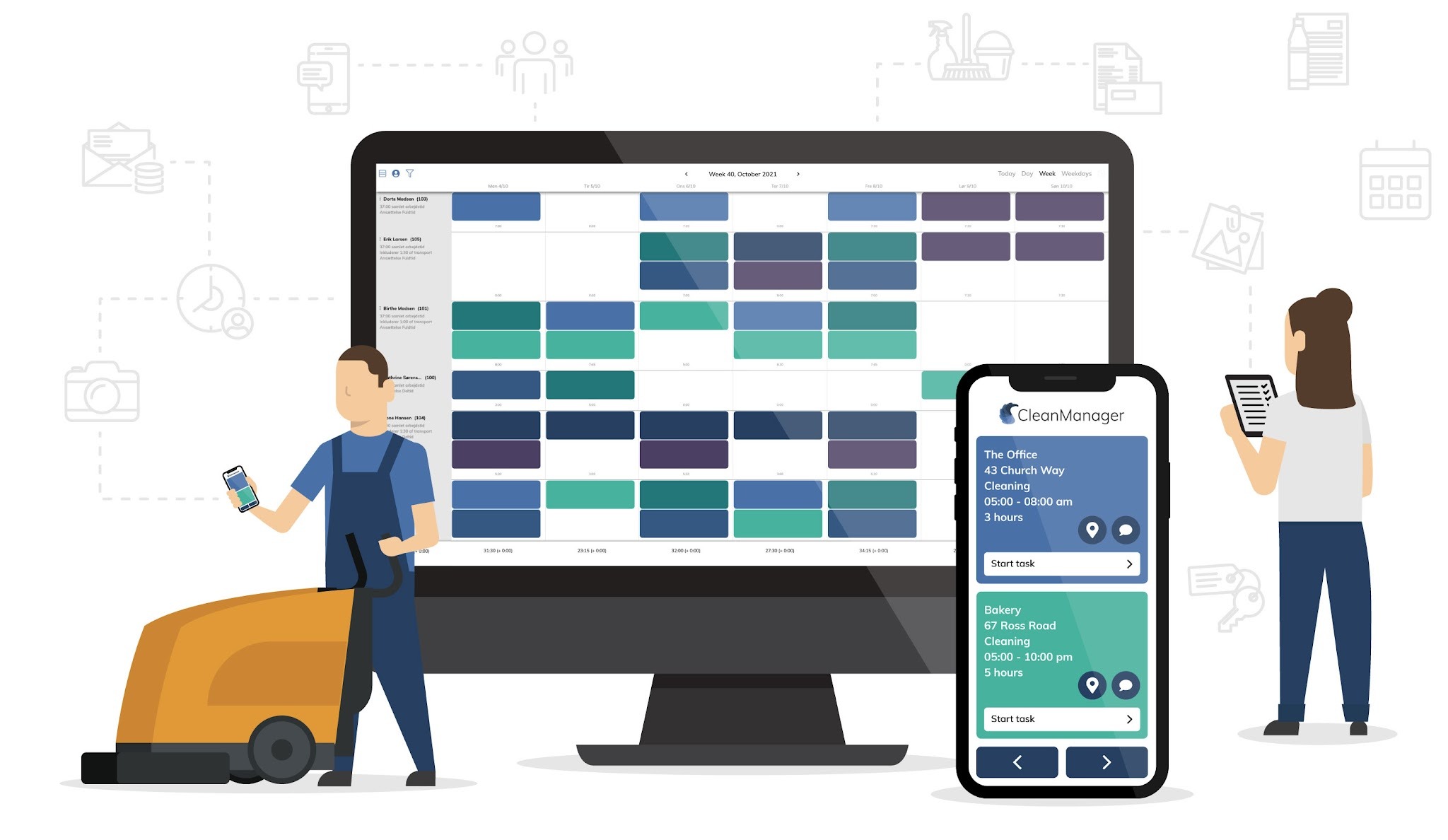
Discuss where your cleaning business could benefit from better digital processes and how CleanManager can help you improve scheduling and documentation in 2027.
We also keep an eye on industry developments and share relevant updates on the CleanManager blog, helping you stay informed about changes that could affect your cleaning business.
Legal information reviewed against published UK government guidance on 27 October 2026.